AI-translated. Read the original in KoreanEmbedded slides, videos and images remain in their original language.
The Product Strategy Pyramid: How Buzzvil’s Product Team Works, Part 2

CPO
I'm Whale, Buzzvil's CPO. I started this series to look back on 2021, and suddenly it is already 2022. Last year was full of experiments, reflection, and growth at Buzzvil. In this post, I will share how our product team worked to grow both our products and our business throughout 2021.
In this series
- A customer-centric strategy: reorganizing groups and using NPS
- Product vision, strategy, and roadmap: the product strategy pyramid
- Different approaches to product development
Product identity
As a product grows beyond early adopters, crosses the chasm—the drop or plateau in demand between early and mainstream markets—and reaches pragmatic customers, it encounters problems that did not exist at the beginning. Early adopters may feel attached to the existing product, resist change, and want something narrower but more specialized. New, pragmatic customers may ask for a broader range of commonly needed features and changes to accommodate them.
As customers become more diverse and requests multiply, those requests start to conflict. If you discuss and respond to each issue in a hurry, it becomes easy to lose track of where the product is heading. As I discussed in the previous post, simply attending to customer requests, rather than taking a customer-centric approach, can turn a product into a chimera.
Buzzvil encountered these problems as we grew. We began with the lock-screen service Honeyscreen, then expanded into a B2B product that let customers add lock-screen functionality to their own services. We later extended our products beyond the lock screen to placements within services, establishing ourselves as a rewarded advertising platform. Along the way, some customers wanted us to concentrate on the lock-screen experience, while others wanted us to increase their service revenue.
Having decided to organize our groups around customers, we needed to revisit and redefine our products' identities.
Product roadmaps: time won't wait for us
Meanwhile, the work in front of us did not wait for us to decide where the products should go. Work started before the reorganization continued, as did essential operational tasks and things we kept doing because we always had. It would have been nice to stop everything and rethink the products, but as a startup, we had to assemble the wings while the plane was flying.
Our first attempt to manage the work after the reorganization was to build product roadmaps. Ownership of many initiatives had changed significantly. Teams struggled to decide what to prioritize, and partner teams could not tell when or how the work they were waiting for would happen. By creating, sharing, and coordinating quarterly roadmaps for each team, we began to untangle the mess.
There are many ways to build a product roadmap. Even when the final artifacts look similar, the process varies with their purpose. Beyond the types below, there are many other definitions, including portfolio roadmaps and strategic roadmaps.
- Internal roadmap: A roadmap for internal operations. Depending on its main audience, it may be an engineering, sales, or management roadmap, each requiring different information.
- External roadmap: A roadmap for customers. It shares the next products or features they can expect and should give them something to look forward to.
- Goal-oriented roadmap: A roadmap organized around goals. Teams using OKRs can structure it around Objectives or Key Results.
- Feature-based roadmap: A roadmap organized by features. It is harder to see the big picture, but it shows when individual features are expected to be developed and released.
- Release roadmap: A type of external roadmap that includes major release dates and the products and features planned for each release.
To address the immediate problems, we first built a feature-based roadmap for one quarter. Each team listed its work and coordinated priorities with related teams. Even planning a single quarter took substantial communication. Fortunately, once the plan was in place, each team could move forward independently.
The quarterly roadmap gave us a little breathing room to plan further ahead. But when we tried to create a roadmap for the whole year, a feature-based approach proved too detailed: difficult to plan and likely difficult to follow. More importantly, it could not clearly express the product team's overall direction. Yet without a plan, we worried our focus would shift from quarter to quarter.
After considerable discussion, we decided to create a release roadmap at roughly quarterly intervals. Instead of specifying weeks or months, we outlined which products or features we intended to release each quarter. The plan was likely to change and the dates were uncertain, but it gave us a sense of how we wanted to spend the year.
Looking back after the year ended, many dates had indeed changed, but our overall direction had remained largely intact. Still, even with a year-long release roadmap, people inside the organization continued to say they did not understand where our products were heading. The limits of a roadmap alone were becoming clear.
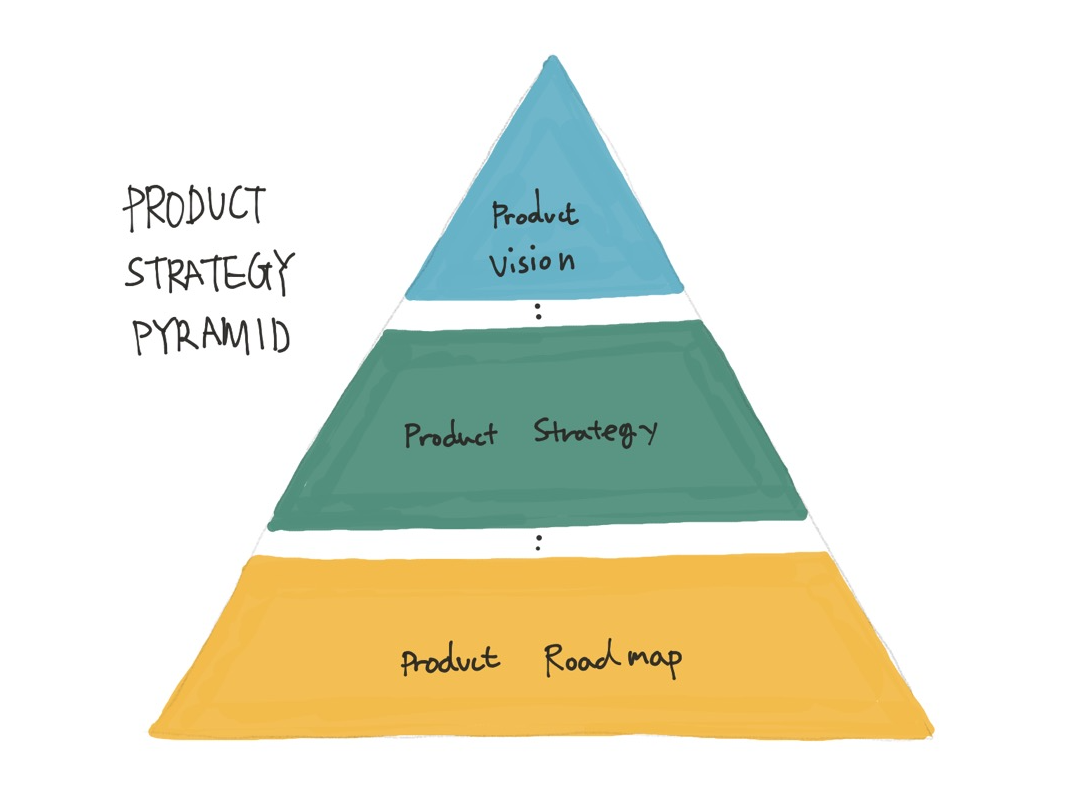
The product strategy pyramid
A roadmap helps people work toward a plan, but it is less effective at keeping them focused on core value or adapting to change. Even though we acknowledged that plans could change at any time and tried to stay flexible, changing course during execution still felt psychologically difficult. New insights and promising opportunities were not always enough to make a sudden shift easy.
A roadmap could not provide the product's center of gravity. That had to come from its vision and strategy. With a new organization and more clearly defined customers, we needed to revisit the product vision as well. We had created the roadmap first to deal with urgent work, but even if it was a little late, we needed a vision and strategy to anchor the product.
Product vision
A product vision describes the future we want to create through the product. It should help the organization plan more concretely how to fulfill the company's mission. It needs to inspire, offer a clear direction while leaving the approach flexible, and focus on problems rather than solutions. Defining just one or two sentences requires a great deal of thought and discussion.
The Demand and Supply groups each defined a product vision around their own customers. A product vision usually describes a future two to five years away, but to reduce uncertainty after the reorganization, each group worked with a horizon of roughly one year.
When we reconsidered what had seemed like an obvious product vision through the lens of our customers, the two groups arrived at completely different definitions. Demand defined a vision for delivering more value to advertisers in the ad-tech market. Supply defined one for helping customers grow their digital services. Different visions meant different work.
Product strategy
Product strategy expresses the plan for realizing the vision. It defines what product to use, for whom, when, and how. There are many ways to develop a strategy, but most good strategies clearly define the customer and the problem. They also tend to focus on one market or customer group at a time.
The Supply group divided customers into three groups based on the nature of their services. Although we aimed for broad categories, defining the criteria took more than a month of discussion. We gathered information, proposed criteria, grouped customers, evaluated whether the distinctions were meaningful, and repeated the process. We hoped for a mutually exclusive and collectively exhaustive (MECE) classification, but perfect boundaries were hard to find. After lengthy discussions, we settled on groups that made sense from business, product, and management perspectives.
Once we had defined the groups, we chose which ones to prioritize. In hindsight, defining the groups had only been the beginning. Different teams and functions brought different contexts and perspectives, so opinions varied on how broadly to define the customers we should focus on. Reaching agreement required more research, discussion, validation, and experimentation. Following Buzzvil's working principle of debating rigorously and committing to the decision once made, we defined our priority customer groups and moved into execution. Because those priorities can change or expand over time, we continue to review and discuss them.
Looking back
Without a product roadmap, it would have been hard to know what to work on two weeks later or what our products would look like a month later. Without a vision, we could not have understood what we hoped to achieve. Without a strategy, we would not have known why we were building a particular product at that moment. Together, vision, strategy, and roadmap helped us navigate the company-wide uncertainty after the reorganization and achieve rapid growth in both products and business.
Despite those efforts, we still occasionally heard that people did not know where we were heading. Discussions among directly involved colleagues, a few internal presentations, and vision, strategy, and roadmap documents stored somewhere were not enough to create a shared understanding. In the strategy pyramid—vision, strategy, then roadmap—the higher you go, the more abstract and broad the ideas become. The less concrete an idea is, the more carefully it needs to be explained and the more often it needs to be reinforced. If I could return to 2021, I would seek more input, debate more thoroughly, and create more opportunities to explain the pyramid as we built it.
Time and people are always in short supply. Trying to do everything can leave you accomplishing nothing. At Buzzvil, we continually question, discuss, and refine what to focus on, guided by our product vision and strategy. Thanks to our colleagues, the product team can take on a wide range of challenges without fear and grow quickly through them. Of course, there is still plenty to do to develop a more ambitious vision and a clearer strategy.
I'll close by sharing that we are looking for colleagues to join us on this journey. In the next post, I will introduce the methods Buzzvil's product team has used to prioritize its work.