AI-translated. Read the original in KoreanEmbedded slides, videos and images remain in their original language.
A Customer-Centric Strategy: How Buzzvil’s Product Team Works, Part 1

CPO
I'm Whale, Buzzvil's CPO. Somehow, 2021 has already flown by. For Buzzvil, it has been a year of experiments, reflection, and growth. In this series, I would like to introduce the ways our product team has worked this year to grow our products and business.
In this series
- A customer-centric strategy: group organization and NPS
- Product vision, strategy, and roadmap: the product strategy pyramid
- Different approaches to product development
A customer-centric strategy
“Customer-focused” and “customer-centric” mean different things. A customer-focused strategy tends to aim at providing the best service to satisfy customers. A customer-centric strategy is more about understanding customers and thinking from their perspective to uncover their problems and needs. You could describe customer focus as an outside-in approach, and customer centricity as an inside-out approach.
For example, if a customer comes to buy a digital camera, a customer-centric approach would ask about their situation—perhaps a busy working mother wants an easy way to share photos of her child with family—and then recommend the product she needs. A customer-focused approach would immediately ask what camera resolution she wants and recommend products that match. Best Buy reportedly increased sales by 9% by moving from customer focus to customer centricity.
If we had to choose keywords for Buzzvil's year, “customer-centric” would certainly be one. Product teams constantly face hypotheses, requests, mountains of ideas, and backlogs, and must decide what matters. A customer-centric strategy helped our team stay on course and identify and solve the problems that mattered from the customer's perspective.
Dividing groups and organizing teams
At the beginning of 2021, Buzzvil divided the organization into groups based on our customers to strengthen customer-centric thinking. We were still a startup with around 100 people, but dividing the entire company into two major groups was an enormous change. For the product organization, it meant reorganizing every team.
The process was painful. As always, time was short and opinions varied. Dividing ownership of products and services that predated the split was difficult too. In line with Conway's Law, Buzzvil's systems reflected the structure of the organization. When that structure changed, some services lost clear ownership while others belonged to both groups.
We needed principles for forming teams. Broadly, there were five possible approaches.
- Product-based teams: Organize around individual products, such as action-based advertising or monetization tools.
- Layer-based teams: Organize around product layers, such as an SDK team or engine team.
- Customer-based teams: Organize around customer groups, such as a commerce advertising team.
- Function-based teams: Group people doing the same kind of work, such as planning or server development.
- Goal-based teams: Organize around target KPIs, such as page views or ARPU.
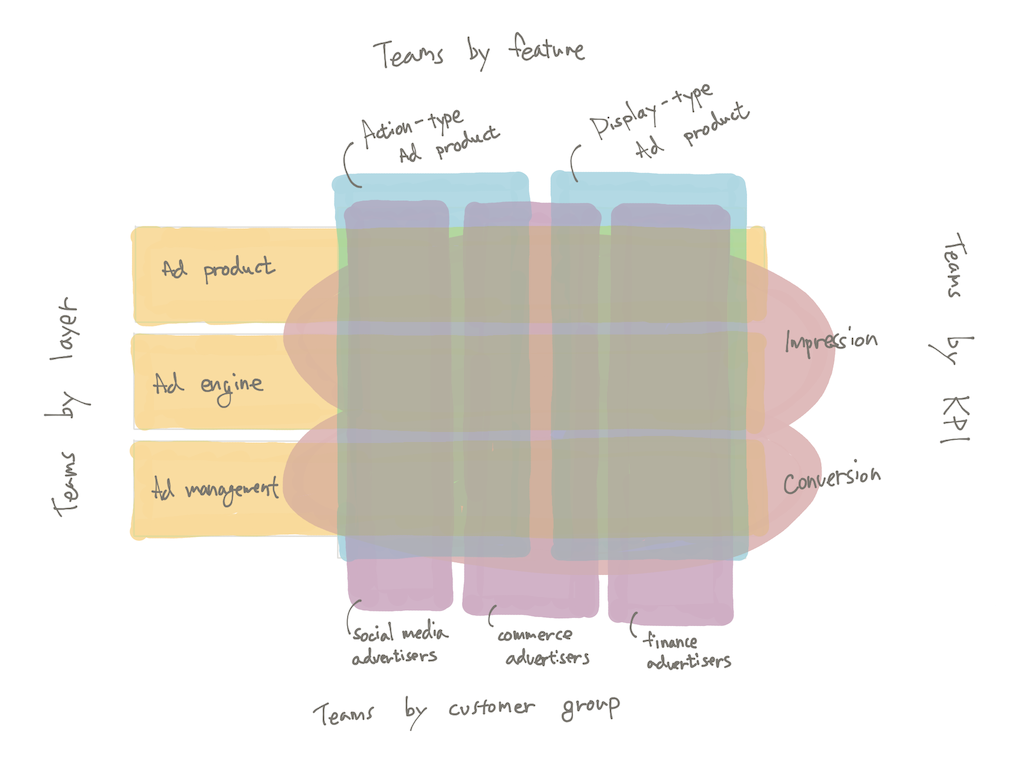
Each approach had advantages and disadvantages. Customer-based teams aligned with customer-centric thinking, but risked creating silos in which teams independently built similar things. Goal-based teams had clear targets, but ownership of individual features was difficult to assign. Function-based teams struggled to work toward a shared purpose, layer-based teams needed cross-team collaboration to achieve goals, and product-based teams left many gray areas. There was, unsurprisingly, no one-size-fits-all answer.
After much thought, we accepted that we could not produce the complete blueprint immediately and decided to mature the organization one step at a time. We divided the organizational evolution into stages, describing each stage's characteristics and the conditions for moving to the next.
The Demand group organized its teams by layer. We divided the product into ad offerings, the ad engine, and ad management tools, with a team responsible for each. After roughly a quarter of learning and stabilization, the ad offerings team split into action-based and impression-based advertising teams.
The Supply group organized around KPIs. This gave each team the advantage of owning a metric from end to end. On the other hand, some projects had ambiguous product ownership. After several experiments, the group now has layer-based teams and is moving toward product-based teams.
For 2022, we are preparing to apply the team structures proposed in Team Topologies. I will discuss that further in the final installment.
Net Promoter Score (NPS)
Since 2020, we had periodically discussed using NPS to measure customer satisfaction. Once we began pursuing a company-wide customer-centric strategy in 2021, we started collecting it in earnest. Previously, as an advertising platform, we had to consider three customer groups—publishers, advertisers, and users—which made focus difficult. Dividing the organization around customers clarified what needed to be done.
The Demand group went first. With Young's enthusiastic support, the sales team led an NPS survey, and we discussed the analysis together. Alongside the score question, we asked why customers would or would not recommend us, giving us deeper insight into their thinking. This helped us quickly identify their major problems. By addressing those problems, we raised NPS from 7 to as high as 40.
Listening to customers is crucial for a product team. Everyone knows this, but doing it is harder than it sounds. Unless you have a dedicated customer development team—and even if you do—you need to find ways to communicate directly with customers and solve their problems. It is easy to give customers what they ask for while overlooking what they actually need.
NPS does not solve every customer development challenge. But it is certainly a useful way to hear customers directly, and a valuable measure of how well we are doing from their perspective. Being able to measure customer-related outcomes matters. As the well-known saying attributed to Peter Drucker goes, you cannot manage what you cannot measure.
Closing thoughts
“Ideas are easy. Execution is everything.”
- Venture Capitalist John Doerr
Ideas are easy. Saying we should be customer-centric is easy too. Ultimately, it comes down to how we put that into practice.
Buzzvil moved quickly enough to split the entire organization into two groups in a month and settle the structure within a quarter. I was part of the work, yet I still wonder how we pulled it off so well. I believe it was possible because the vision of our two CEOs, Young and John, came together with every Buzzvilian's ability to execute. Of course, there is always room for improvement, and we still have a long way to go. I am excited to see what changes we can make next year.
In the next installment, I will look more closely at the product team's efforts to develop and execute product strategy.