AI-translated. Read the original in KoreanEmbedded slides, videos and images remain in their original language.
Addicted to Bullet Points

CPO

TL;DR Indiscriminate use of bullet points is bad for your health.
Lately, I have been seeing a lot of writing that overuses bullet points. They appear where a detailed explanation is needed, where a comparison would be more useful, and even where there is just one sentence to say. Do you use bullet points like the example below? If nothing about it bothers you, feel free to stop reading here.
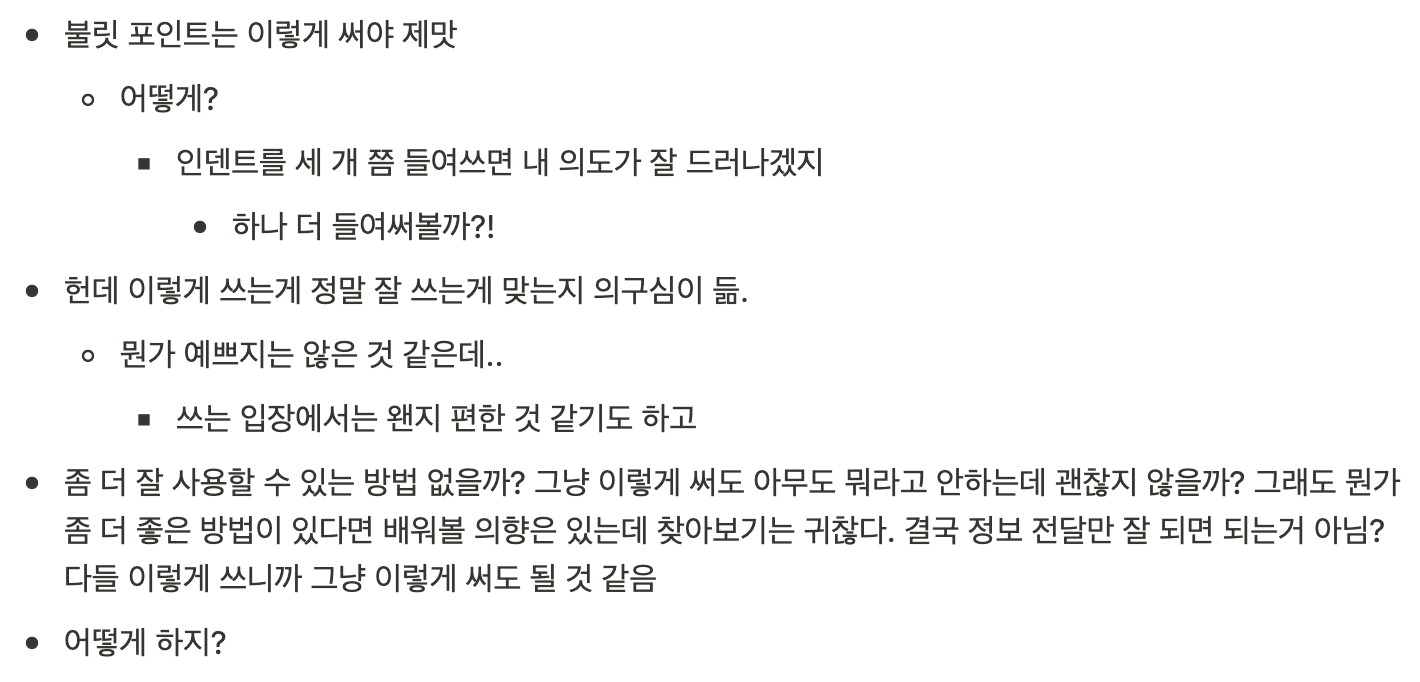
A guide to bullet points
Used well, bullet points are a great tool for communicating information and arguments. Used poorly, they can make writing harder to understand. A few simple rules can make your writing cleaner and easier to read. Here are the recommendations that come up across several articles on the subject.
- Group related items together.
- Keep each item short.
- Use a consistent structure for every item.
- Keep items parallel.
- Use a period only when the item is a complete sentence.
When individual items need an explanation, you can also use this format:
- Keep it simple. Reduce unnecessary complexity and avoid nested bullets where possible.
- Avoid overuse. Be careful not to make your writing look like a shopping list.
Simply telling yourself to use fewer bullets can be harder than it sounds. “Is a one-sentence paragraph okay?” “Will adding unnecessary prose make my main point harder to communicate?” These are understandable concerns. Trying too hard to construct paragraphs can also lead you to repeat similar sentences.
The alternatives below can help you communicate the main point clearly while cutting back on indiscriminate bullet use.
| Alternative | When to use it | Advantages | Drawbacks |
|---|---|---|---|
| A paragraph with the main point first | When a detailed explanation is needed. | Separates the main statement from supporting details and communicates information effectively. | Writing a good paragraph is difficult. |
| A table | When comparing multiple items. | Makes it easy to communicate information for each item. | Becomes harder to read when the content is long. |
| A numbered list | When sequence matters or you need to refer to individual items. | Makes the order clear. | Like bullet points, it needs to stay simple. |
Wrapping up
Amazon replaced PowerPoint in meetings with the six-pager: a six-page narrative. Jeff Bezos has said the approach was introduced because the human brain processes narratives better than bullet points packed with hard data. Even in these six-pagers, bullets are reportedly permitted in only two places, including the Goals section.
I have heard that large Korean companies once required employees to write in the terse “-eum” style—for example, abbreviated endings meaning “was done” or “did”—to communicate information more efficiently. When I heard this as a student, I wondered why a company would dictate something like that. But the intention seems similar to that behind the six-pager: an effort to communicate efficiently and accurately so that people can make sound decisions. I still disagree with making that writing style compulsory, but finding better ways to communicate is worth continued thought.
I wrote this short reflection in the hope that all of us who have become addicted through overexposure to bullets in Notion, Confluence, and similar tools can recover together. To my fellow addicts, myself included: we can do this 😉
References
- How to Write Powerful Bullet Points
- The Anatomy of an Amazon 6-pager
- Best Practices for Bullet Points